
Schoolcraft Deed Record Types
Schoolcraft County deed records cover every instrument the Clerk and Register of Deeds accepts. That office handles the recording. A deed transfers the interest its text describes. Other instruments do different work. A mortgage, assignment, discharge, lien, release, easement, covenant, affidavit, or plat can affect the same parcel. None of them serve that role. Read the image and its related references. Do not treat every indexed document as a sale.
| Deed type | What it does | Common record use |
|---|---|---|
| Warranty deed | Conveys the stated land interest with covenants in the instrument | Documenting a conventional transfer |
| Quitclaim deed | Conveys whatever interest the grantor has, if any | Family, trust, or title-cleanup transfers |
| Personal representative deed | Conveys estate property through authorized administration | Following a probate-linked transfer |
| Trust deed or related conveyance | Moves an interest into or out of a trust | Tracing trustee and trust ownership |
| Tax or foreclosure deed | Records a transfer arising from a statutory or court process | Reviewing distressed-property history |
LandShark's document-type menu loads with the live application itself. A static list cannot reproduce every Schoolcraft instrument label. Pick document types from the actual dropdown when you search.
Schoolcraft LandShark Index
LandShark is Schoolcraft County's layer for recorded instruments. It offers search routes by address, book and page, date, document number, legal description, name, parcel ID, grantor-grantee book, tract book, plat, and tax lien. Its name search covers grantors only, grantees only, or both, with fields for a business or last name, first name, and middle initial. The county calls it a working index. New entries receive double-entry verification. Original index errors and omissions can still remain. Run the same tract through names, parcel or legal description, dates, and known document references. One spelling miss proves little. The Schoolcraft LandShark application is the official online doorway for the county's deed index.
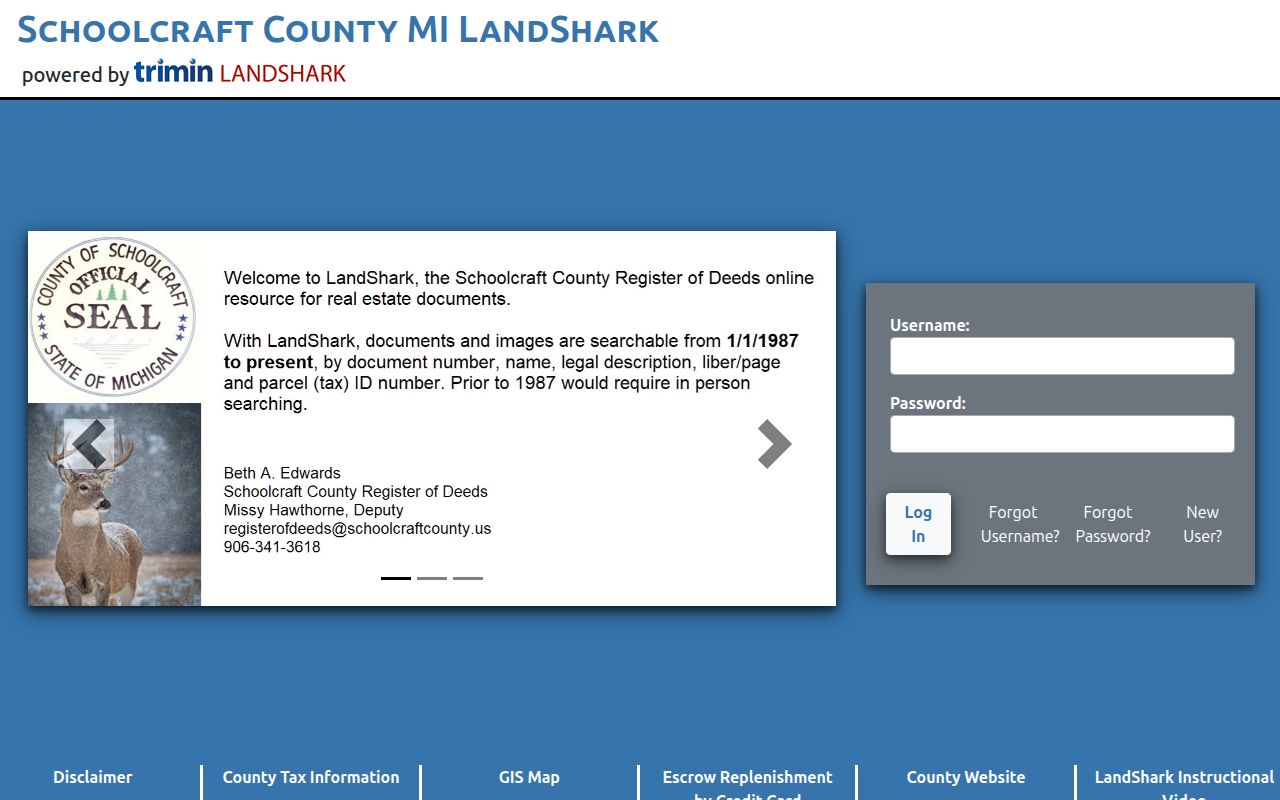
The image shows the county's official LandShark portal page. A live JavaScript session, not the picture, controls the current search form and result display.
Schoolcraft Deed Search Fields
No single index key survives every transfer. So the Schoolcraft portal offers several deed search paths. A legal description is safer when a surname changed, a business dissolved, or the parcel was split. A book and page or a document number goes straight to a known recording.
| LandShark route | Entry | Best use | Known limit |
|---|---|---|---|
| Name | Business or last name, first, middle initial, party role | Finding grantor and grantee entries | Spelling and role can vary |
| Date | From and to dates | Narrowing a known transfer period | Recording date may follow signing |
| Document number | Instrument reference | Opening a cited record | Requires an exact known number |
| Book and page | Volume and page reference | Following older citations | Label conventions can differ by series |
| Legal description or tract | Lot, section, or indexed land text | Finding land when names miss | Exact index terms matter |
| Parcel ID | Modern parcel key | Connecting a current parcel to documents | Older instruments may lack the current PIN |
The search routes are open to anyone. Results and image access can depend on fee settings. The county publishes no full document-type menu, page-size cap, or public image price for the LandShark portal.
Schoolcraft Grantor-Grantee Chain
A chain of title follows one tract through every conveyance, in order. Start with a current parcel result. Take just the names and the legal description. Then use Schoolcraft County deed records to locate the latest acquiring instrument, and read each image before stepping backward through the grantor-grantee chain.
- Search the current owner as grantee and compare the parcel, legal description, and date.
- Open the likely deed and record the grantor, grantee, document number or book and page, and recording date.
- Search that grantor as a grantee to locate the deed by which the prior owner acquired the tract.
- Repeat the name search, checking the tract index whenever spelling, estate, trust, or parcel changes break the link.
- Move to office indexes and older deed books when the verified online coverage ends.
- Grantor
- The party giving or conveying the stated interest.
- Grantee
- The party receiving the stated interest.
- Chain of title
- The linked sequence of recorded transfers for the same land.
- Book and page
- A volume and page citation used to retrieve a recorded item.
- Instrument number
- A unique document reference assigned in the recording system.
Tracing owners further back takes a different workflow. The former property owners page focuses on rebuilding the prior chain rather than pulling a single instrument.
Schoolcraft New Deed Timing
A newly recorded deed can reach the party and tract indexes before its image is finished. The LandShark disclaimer puts images online by noon of the next working day. Heavy recording volume can stretch that to two weeks. A fresh index line without an image is often just timing. That delay says nothing about the assessment roll, though. Schoolcraft County publishes no fixed interval between a closing, recording, and a changed owner field on the tax roll. For a recent transfer, note the instrument reference first. Ask the Register of Deeds about image status. If the roll still names the prior owner, check with the local assessor separately. The two offices update on their own schedules.
Recent filing tip. An index entry and its image can appear at different times, so save the document number before leaving the result.
Schoolcraft Deeds Since 1871
Schoolcraft County's land records begin in 1871, the year the county became fully organized. That date covers the county collection, not complete online coverage. LandShark's public index and image cutoff is not stated. Ask the Register of Deeds about older years. Some still require a paper index, deed book, microfilm, or an office terminal. Older tracts can reach past the county's own series. Schoolcraft County was first created in 1843 from predecessor county territory. Federal patents and survey plats can predate full organization. The Library of Michigan Schoolcraft guide helps identify those older series. The Archives of Michigan county guides help as well. Manistique's library holds newspaper microfilm back to the late 1800s. Sale notices there can add property context. Newspaper text is never a deed, though.
Schoolcraft Older Image Quality
Age and legibility are different problems in Schoolcraft County deed records. The LandShark notice warns that older originals scan poorly. Blue or light ink often failed to reproduce. That matters here. Schoolcraft County imposed no document-legibility requirement until 1997. So a faint image may faithfully show a faint original, not a scanning error.
Work around a hard-to-read deed instead of guessing. Pull the book-and-page or tract citation and enlarge the image if the portal allows it. Cross-check party names against the index. If key words stay murky, ask the Register of Deeds whether an original book or office copy can be reviewed. Never reconstruct an unreadable legal description from memory. One changed lot number or section reference can describe entirely different land.
Schoolcraft Land Notification Gap
The county clerk page posts a "Land Notifications" link beside LandShark. The page does not state its signup fields, cost, or exact function. A separate county alert directory lists Schoolcraft as unavailable. Those two facts cannot be blended into a promise. No county property-fraud alert is a sure thing yet.
Ask the Schoolcraft County Clerk and Register of Deeds whether the notification tool now accepts public enrollment. Ask also which events it monitors. Notice alone never blocks a recording. It also cannot prove fraud. Regular checks of Schoolcraft County deed records remain the sound response to any instrument that seems wrong. Prompt contact with the office matters just as much.
Schoolcraft Deed Copy Options
Deed copies come from the Clerk and Register of Deeds, located at 300 Walnut Street, Room 164, in Manistique, MI 49854. The office number is 906-341-3618, and the county directory lists weekday hours of 8 a.m. to 4 p.m. A strong request names the parties, the approximate recording year, the document number or book and page, and the parcel or legal description tied to the deed.
The county fee schedule posts $1 for a recorded copy, $2 for a plat copy, and $5 for certification. Recording a new document costs $30. That fee is separate from buying a copy. You can order at the counter or by mail once the office confirms the record and the payment method. LandShark questions also go to registerofdeeds@schoolcraftcounty.us.
For an existing administrative record outside the deed portal, written Michigan FOIA requests are accepted by email, fax, mail, in person, or another written method the county recognizes. FOIA obtains records that already exist. It does not require county staff to research a chain of title or build a new report for a requester.
Recorded, not guaranteed. The deed index shows instruments placed on record, but it is not a title opinion and may not disclose an unrecorded claim.
A certified copy confirms the office's copy of a recorded item. It does not settle whether the full title is clear.