
How to Find Who Owns a Schoolcraft County Property
The practical path runs from an easy location clue to recorded proof. BS&A and FetchGIS locate the parcel. LandShark then supplies the grantor-grantee and tract index. Keep the PIN, local unit, and legal description beside the name, because a same-name match can point to the wrong piece of land.
- Search the address in Schoolcraft County BS&A or FetchGIS and select the matching parcel.
- Copy the PIN, local unit, tax description, and displayed owner or owner-address information.
- Search LandShark by grantee, parcel, tract, or legal description for the latest conveyance.
- Compare grantee, recording date, document number, and legal description with the mapped parcel.
- If an entity owns it, use Michigan's business registry for entity context without treating the registered agent as the owner.
Start the Schoolcraft County Owner Search by Address
BS&A's county page offers three search tabs. Address, Name, and Parcel Number are the public starting keys. FetchGIS adds Street Address within Parcel Search, plus intersection and coordinate routes. An address can miss. Drop postal assumptions and try the road name, owner, PIN, or a map point instead. Rural E911 changes add confusion. Private-road names can separate a familiar address from the legal land key. The official Schoolcraft County BS&A page shows all three keys in one place.
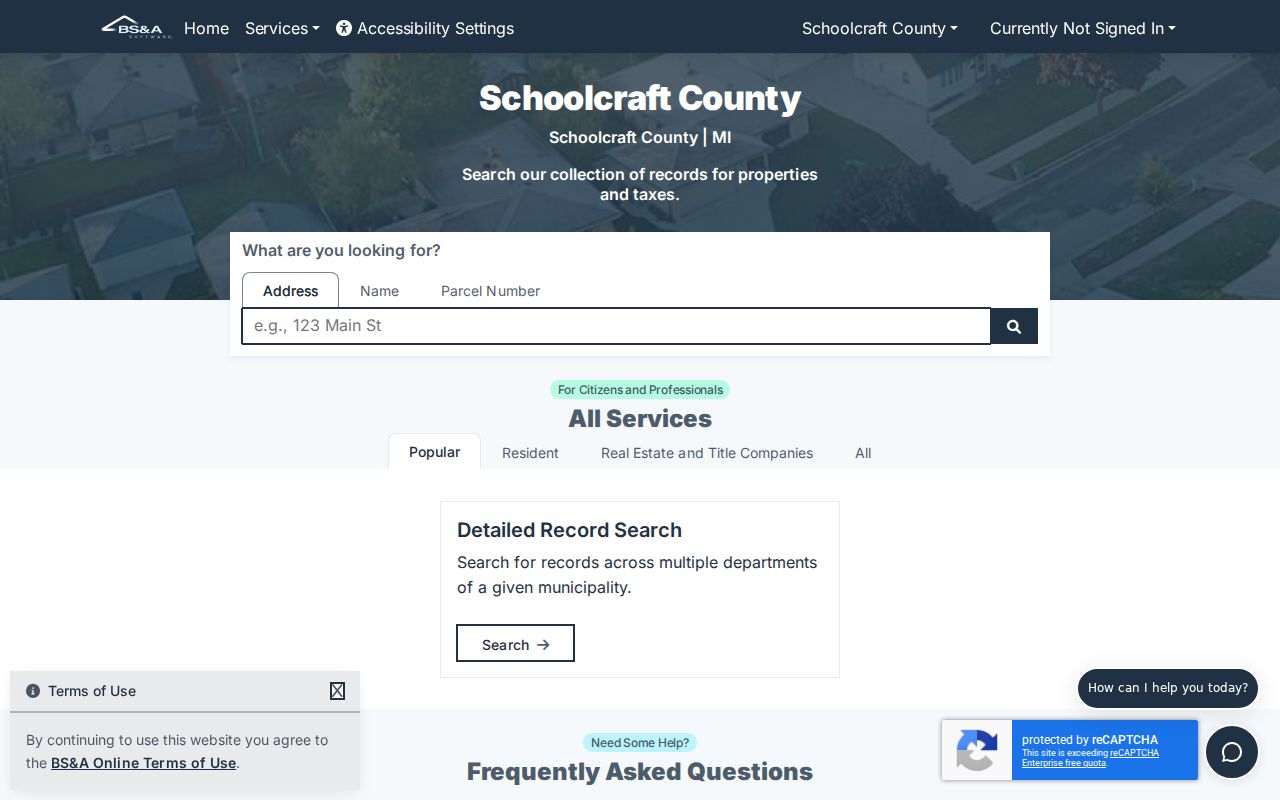
The BS&A landing page shows an address clue becoming a parcel result before any deed confirmation. Check the local unit first. A 49854 Manistique mailing address can sit in Manistique city, Manistique Township, or nearby rural delivery. Assessment duty follows the parcel's jurisdiction. The wording on an envelope does not control it.
Read the Schoolcraft County Owner and Parcel Fields
FetchGIS labels Property Address and Owner Address separately. Its parcel reports can include unit, unit name, acreage, zoning, tax description, value history, sales information, and building detail. Owner-name labels vary by view. Do not assume every parcel report displays the same owner field. BS&A's Name search is the other locating route.
- Owner of record
- The party carried on the public assessment or ownership roll for that parcel and tax cycle.
- Vesting
- The way a recorded deed states that title is held, including multiple parties or an entity.
- Grantee
- The party receiving an interest in a recorded conveyance.
- Situs address
- The physical property address used for mapping, assessment, and E911.
- Owner mailing address
- The destination for notices, which may differ from the property and does not prove residence.
Sources That Answer Who Owns in Schoolcraft County
No single Schoolcraft County source answers every ownership question. The roll is the fast present-day locator. The map fixes that result to actual land, and the newest deed records the conveyance itself. Entity and probate records matter only when the named owner requires another step.
| Public source | Ownership clue | How to reach it |
|---|---|---|
| BS&A local-unit roll | Name search, parcel, assessment and tax context | County portal by address, name, or parcel |
| FetchGIS | Mapped parcel, owner address, unit and tax description | Public CUPPAD viewer |
| LandShark | Latest deed's grantee, index references and image | Name, tract, legal, parcel, document, or book/page routes |
| MiBusiness Registry | Entity filing and registered-office context | Michigan public business search |
| Probate Court | Estate case, representative, orders, and heirship context | MiCOURT locator, then local file |
Occupants mislead. A resident may rent, stay with the owner, hold an unrecorded interest, or just receive mail at the property. Owners mislead too. An owner of record may live elsewhere and use a mailing address outside the county, so ownership research answers the title and roll question rather than who lives on the site.
Confirm a Schoolcraft County Property Owner in LandShark
The Schoolcraft County Clerk and Register of Deeds maintains LandShark. Search modes include Name, Legal Description, Parcel ID, Address, Document Number, Date, Book and Page, Plat, Grantor-Grantee Book, and tract-book routes. Name search takes a business or last name, first name, middle initial, AND/OR logic, and grantor, grantee, or both roles.
Run the roll name as grantee, then grantor. Repeat with the PIN or legal description. LandShark warns that its working index can carry original errors or omissions and urges multiple search methods. Always read the recorded image. Check it for grantee, vesting, legal description, and recording details.
Note: Images usually appear by noon of the next working day, but high volume may delay completion up to two weeks.
When a Schoolcraft County Property Owner Is an Entity
An LLC, corporation, trust, estate, or joint ownership can muddy the name. Companies take one extra step. Search the exact deed grantee in the MiBusiness Registry. The registry replaced Michigan's earlier filing platform in June 2025. Its filing and registered-office details can help distinguish entities. A registered agent is not automatically a beneficial owner.
Trusts vary too. A trust may be indexed under the trust, trustee, settlor wording, or an abbreviated name. Search those variants and confirm the deed. If an owner died, the Probate Court file may show a personal representative or transfer order. LandShark shows the later instrument that affects the land. A probate docket is not itself a deed.
Use Legal Descriptions to Avoid Owner Mistakes
Names are weak identifiers. Two people can share a name. An entity can change form, and a parcel can split. The legal description is the durable land clue. Rural deeds may use section, township, and range, while platted property uses a named subdivision with lot and block. The modern PIN joins portals but may not appear on an old deed.
Copy the tax description exactly from the parcel report. Compare it with the recorded image. If a later parcel inherited part of an older tract, follow corrective deeds, prior PIN references, plats, and split instruments. Never pick an owner just because the mailing city and surname look right.
When Schoolcraft County Owner Records Lag a Closing
A deed and the roll update on different schedules. The roll publishes no closing-to-owner refresh time. LandShark documents image timing. It does not guarantee an assessor update. When sources conflict, note the date and tax year each one shows.
The latest recorded deed is the better proof of conveyance. Even the index deserves a check against its image. Ask the local assessor about roll timing. Call the Register of Deeds at 906-341-3618 about a newly filed document. The current Schoolcraft County owner guide focuses on this exact timing problem.
Offline Ways to Verify Who Owns Schoolcraft County Land
A dead end online is not a dead end overall. In-person land-record work happens at the Clerk and Register of Deeds. That office sits in Room 164 of the courthouse at 300 Walnut Street in Manistique. The posted fee schedule sets $1 for a recorded copy and $5 for certification. Bring the parcel number, legal description, and party names. Add an approximate recording year if you can.
Two more offices round out the offline route. Equalization sorts out map and parcel identity questions at 906-341-3677. The Treasurer keeps a public terminal in Room 169. It helps with current or delinquent tax context. When an administrative record exists but is not otherwise available, a written Michigan Freedom of Information Act request works. It can go by email, fax, mail, or in person.
Older house history has one more source. Manistique library newspaper microfilm reaches back to the late 1800s. It can surface notices or earlier address use. Those leads can steer a deed search. They are no substitute for recorded title evidence.
Protected Addresses in Schoolcraft County Owner Research
A substitute or missing mailing address does not mean an owner vanished. Michigan's Address Confidentiality Program supplies an official substitute address. It includes mail forwarding for eligible people at risk. Government bodies must honor that designated address whenever one is required. Other statutory limits on recording or disclosure can apply too.
Keep Schoolcraft County property records pointed at legitimate ends. Think land, tax, boundary, estate, or civic questions. Avoid republishing personal details that have no bearing on the property question. Ask the custodian about redaction or a protected-person process when one applies.
What “Who Owns This Property” Cannot Establish
Public property records have real limits. A record can name the assessed owner and the recorded grantee. It cannot prove who lives there, settle an unrecorded claim, untangle every trust interest, fix a disputed boundary, or stand in for a title opinion. Tax delinquency and a court docket likewise fail, absent a recorded instrument, to shift present ownership of the parcel.
Lawful use. Schoolcraft County owner records support land research and due diligence; using them to stalk, harass, intimidate, or harm anyone is prohibited.
When money, inheritance, litigation, or a contested interest is at stake, pull the source documents and get qualified title help. A portal result is a lead. It is never a guarantee.