
Schoolcraft Former Owners in Reverse
Think of a backward title trail as a series of links. Each deed is one link. The newest instrument names a grantee, the party who received the interest, and a grantor, the party who gave it up. That grantor is your next search term, this time as grantee on an older transfer. The table lays out the columns worth keeping in a research timeline. It shows a worksheet structure only, not a chain for any named parcel.
| Transfer date | Grantor to grantee | Deed type | Book/page or document |
|---|---|---|---|
| Newest matching transfer | Prior holder to current grantee | As indexed and shown on image | Copy exact reference |
| Next older transfer | Earlier holder to prior holder | As recorded | Copy exact reference |
| Pre-digital link | Book-index names | Deed or estate instrument | Book and page |
Record the date, document number, book and page, party roles, document type, and legal description for every link. A warranty deed, quitclaim deed, personal-representative deed, or corrective instrument can each pass along a different kind of interest. The timeline proves only what the documents themselves say. It will not settle unrecorded claims or replace a title opinion.
LandShark Starts the Schoolcraft Chain
Start your Schoolcraft County property search at the Schoolcraft County LandShark index. It lets you search by grantor, by grantee, or in both roles at once. Other routes run through legal description, tract, parcel ID, address, date, document number, book and page, plat, and the grantor-grantee books. Begin with the most recent known owner as grantee. Then use the legal description to weed out same-name hits. Indexing errors and omissions do happen. Try alternate punctuation, initials, business suffixes, and both party roles before giving up. LandShark double-entry verifies its indexes after recording, and it still recommends searching several ways. A matched image should carry the same tract description as the prior link. That could be lot and block, or a section description instead.
See Schoolcraft Deed Search Access
The live LandShark application is the public door to Schoolcraft County grantor-grantee and tract searching. The landing page confirms the service exists. Building a real chain still takes interactive searches and image review by hand.
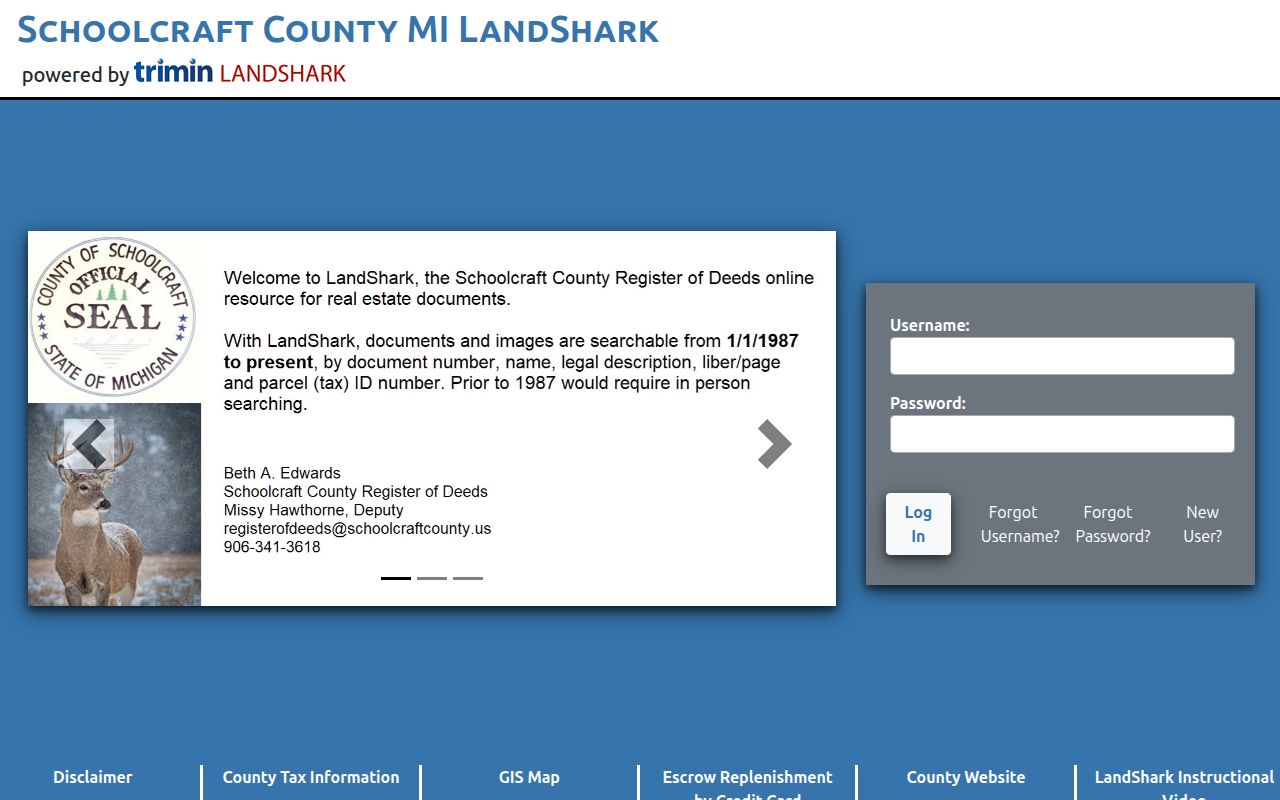
The screen names no online starting year. Treat a missing result as a cue to try another key, and ask the Register of Deeds about older books.
Reconstruct Schoolcraft Ownership Backward
Keep the parcel fixed. Move through time one transfer at a time. A clean worksheet protects you when a common surname, a split parcel, or a corrected deed tries to pull the search onto different land.
- Locate the current parcel in BS&A or FetchGIS and copy its PIN and tax or legal description.
- Find the newest matching conveyance in LandShark. Record the grantee and the grantor exactly as indexed.
- Search that grantor as a grantee in an earlier date range. Compare each new result's land description.
- Follow corrective deeds, assignments, probate transfers, and references to related documents before moving farther back.
- When the digital search stops, take the last known name, date, book/page, and description to the deed-book or tract index.
- Grantor
- The party conveying the interest described in an instrument.
- Grantee
- The party receiving that stated interest.
- Chain of title
- The ordered series of instruments connecting holders through time.
- Reverse index
- An index organized to help find a party in the opposite deed role.
- Quitclaim and warranty deed
- Different forms of conveyance; neither label alone proves a flawless chain.
Schoolcraft Records Begin in 1871
Schoolcraft County existed before then. Full organization came in 1871, and the local genealogy resource dates county land records from that same year. That makes 1871 the practical starting point for the deed series. It promises no online index of every deed. LandShark publishes no exact index or image cutoff.
Online limit. Schoolcraft land records start in 1871, but the online cutoff is unconfirmed; ask for deed books, tract indexes, and microfilm.
For an older tract, federal patents, survey plats, and predecessor-county records may all matter. Ask the Register of Deeds or the Archives of Michigan before assuming the chain ends. No courthouse fire or lost-book period appears in the record, so do not explain a gap with an invented destruction story.
Older Schoolcraft Images Need Care
LandShark's own disclaimer warns that some older originals are hard to read. Schoolcraft County had no document-legibility requirement until 1997, and blue or light ink reproduces poorly. A faint online image or name entry does not mean the deed is gone. The paper book may still hold it. Ask the office to check the original volume, an alternate index, or the tract entry. This is a records-history problem, not a legal cutoff. Transcribe uncertain words with brackets in your notes. Keep the image reference. Compare names against the neighboring deeds. A plat, mortgage, release, or probate instrument can sometimes confirm a spelling without touching the original text.
Probate Breaks Simple Owner Chains
A former owner may have died without a standard seller-to-buyer deed. Look for a survivorship or death affidavit. Look for a personal-representative deed, a trust conveyance, a recorded court order, or a distribution deed. LandShark may hint at an estate but stop short of the whole transition. The Schoolcraft County Probate Court holds the estate file. MiCOURT may offer a locating case entry. An obituary or the Manistique library's late-1800s newspaper microfilm can supply dates and family names for the next search. Neither can establish title. Match every family-history lead to the probate order and the recorded instrument before adding it to your ownership sequence.
Splits Change Schoolcraft Search Keys
Modern parcel IDs may never appear on old deeds. BS&A displays one parcel mask, while the county 911 form follows a different county-prefixed pattern. A split, combination, plat change, or new E911 address can hand the same ground a fresh key. That fresh key is purely administrative. Legal descriptions hold up better over time. For Manistique lots, compare subdivision, block, and lot against the recorded plat. Rural descriptions lean on section, township, range, acreage, and calls. County plat copies are listed at $2. The Register of Deeds and Treasurer sit on the statutory Plat Book Board. A tax-map polygon helps you locate the land. It is not the chain itself.
Schoolcraft History Beyond the Portal
Online property records have a starting year, and older deeds live on paper. Call the Clerk/Register of Deeds at 906-341-3618 or stop by Room 164 at 300 Walnut Street in Manistique. Ask how far back the online index reaches. Also ask about the paper grantor-grantee index run, deed and mortgage books, tract books, plat volumes, and any microfilm holdings. Mail requests work best when they include the names involved, a date range, the legal description, and the last known recording reference. The more precise the request, the faster staff can pull the right deed records.
Beyond the office, several archives deepen a Schoolcraft County property search. The Library of Michigan county guide catalogs a Schoolcraft County farm and land-ownership atlas, cemetery material, and local histories. Archives of Michigan county guides offer another catalog route, and FamilySearch Affiliate access opens more doors. The local Historical Society maintains an archive project too. For old rolls or administrative maps missing from any portal, a focused county FOIA request can help. Remember, though, that FOIA does not compel staff to build a title chain for you.
Note: A recorded copy costs $1 and certification is listed at $5, so confirm the current fee and retrieval method before ordering.
Limits of Schoolcraft Former-Owner Research
A former-owner chain holds up only when every step carries the same legal description. Each split, estate transfer, or correction needs an explanation. Directory occupants can add helpful context along the way. So can tax-roll names, newspaper notices, and assessor sale lines. Still, none of them replaces the deed itself. The separate Schoolcraft County deed records resource explains how to obtain a particular instrument when you need the actual copy.
Lawful use. Trace previous owners for title, estate, purchase, and house-history work. Never use public records to track, harass, or harm a person.
Gaps happen. When a chain shows a gap, a competing interest, or an uncertain legal description, turn to a title professional or attorney rather than guessing. The public index is only a locating tool. Schoolcraft County itself warns that its working index may contain errors or omissions.
Keep a source log for every link you find. Record the search spelling, the date range, the index role, the image reference, and the office response. That short audit trail makes later corrections far easier.